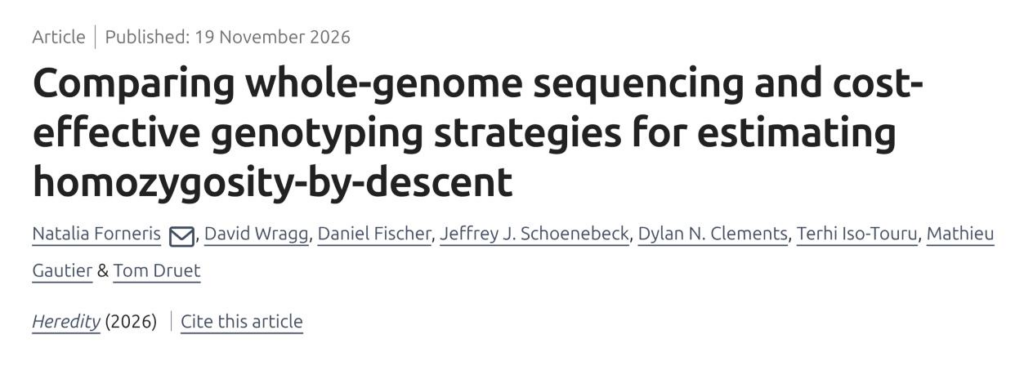
A new article I contributed to has been published in Heredity.
The study, led by Natalia Forneris and Tom Druet at the University of Liège, asks how well inbreeding can be measured when sequencing the whole genome of every animal is too expensive. Inbreeding leaves long stretches in the genome where both copies are identical because they were inherited from the same ancestor. These stretches are called homozygous by descent (HBD) segments, and the share of the genome they cover gives the inbreeding coefficient F.
To find out, we took whole genome sequences of 132 Holstein cattle and thinned them out to mimic cheaper methods, namely small SNP arrays, reduced representation sequencing (such as GBS) and sequencing at low coverage. With model based methods such as those in the R package RZooRoH, F could be estimated reliably from as few as 6,000 array SNPs, from reduced representation data with about 15,000 SNPs, and from sequencing data down to 0.1x coverage. There is one limitation, though. Only the long HBD segments, which go back to recent common ancestors, can be identified reliably. The paper therefore recommends models with several HBD classes, keeping only the classes that can be estimated with confidence.
The main results were confirmed with real data from Labrador Retrievers and from Nordic Red cattle. The cattle GBS data were my contribution and come from our earlier BMC Genomics study on fine tuning GBS data. This is good news for anyone working with wild species, rarely studied organisms or small livestock populations, because cheap genotyping is enough to keep an eye on inbreeding, as long as the right models are used.
The full article is available at Heredity.
Leave a Reply