Category: Luke

  • eggNOG7 annotator script

    For our metagenomics pipeline I wrote a quick and dirty annotator script that can be found here and which might be useful for one or another.

    https://github.com/fischuu/eggnog7_annotator

    The purpose of the tool is that it takes protein sequences from gene predictions and annotates (in the sense of intersects) them with known proteins, their functions and taxonomic origin. That way, the tool can be used to shed a bit of light on plain protein sequences.

    The current eggNOG annotator uses only the database version 5 and was not available for version 6. Now eggNOG 7 was pulbished and we thought within out MetaG pipeline group that it would be good to have a db7 annotator, so we added it to the pipeline and have from that also this stand-alone version linked here.
  • Understanding Whitefish in the Northern Baltic Sea

    Understanding Whitefish in the Northern Baltic Sea

    A new article I contributed to has been published in Fishery Research.

    The study focuses on European whitefish in the northern Baltic Sea, which exist as two types, or ecotypes: one that migrates between rivers and the sea (anadromous) and one that spawns entirely in the sea. These fish are caught together in fisheries, but the river-migrating type is endangered, while the sea-spawning type is doing better.

    We looked at ways to tell the two types apart, using both physical traits and genetic data. This isn’t always straightforward — some fish show mixed traits, likely due to past stocking, habitat changes, or variable migration patterns. We also studied how fishing depth, season, and net size affect which type of fish is caught. The results show that fishing practices can strongly influence catch composition, highlighting that adjusting fishing rules by location and timing could help protect the vulnerable whitefish population.

    The full article is available on ScienceDirect:
    https://www.sciencedirect.com/science/article/pii/S0165783626000019

  • Genomic Prediction for Timothy Grass in Finland

    Genomic Prediction for Timothy Grass in Finland

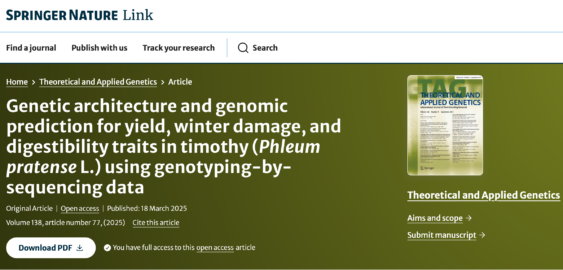
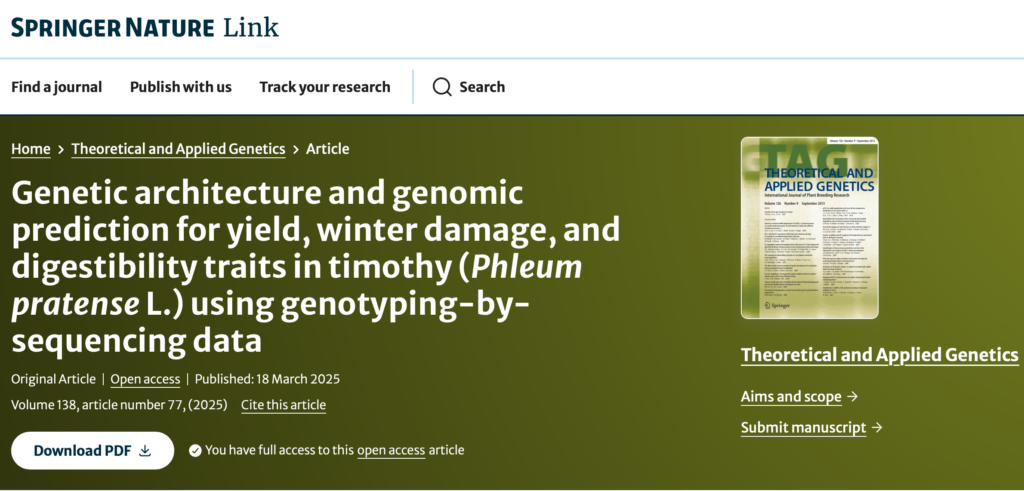
    Timothy (Phleum pratense L.) is a key forage grass for Finnish agriculture, and improving its yield, winter hardiness, and digestibility is crucial for sustainable production. Our recent study explored the potential of genomic prediction to accelerate breeding progress by leveraging genotyping-by-sequencing and advanced statistical models.

    Key findings:
    * Heritability estimates ranged from 0.13 (yield at first cut) to 0.86 (digestibility at second cut).
    * Genetic correlations suggest trade-offs between yield and winter survival but positive links between digestibility traits.
    * Genomic breeding values were estimated using advanced statistical approaches, including a novel scaling of the genomic relationship matrix.
    * Predictive ability reached up to 0.62 for digestibility, and validation confirmed moderate accuracy with little dispersion.

    Despite concerns that genotype quality might impact predictions, our results show that genomic prediction remains a powerful tool for Timothy breeding in Finland. This research highlights the potential for data-driven breeding strategies to enhance forage crop resilience and quality.

    https://link.springer.com/article/10.1007/s00122-025-04860-9

  • Bioinformatics Network Meeting

    Bioinformatics Network Meeting

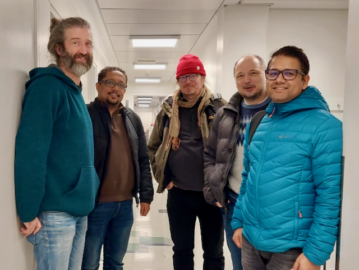
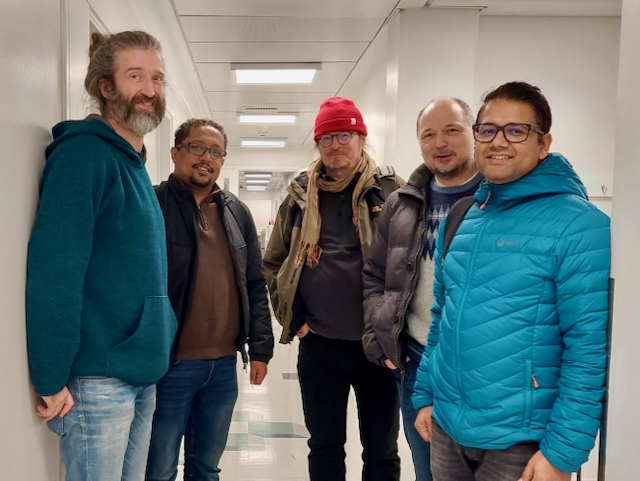
    The last two days we had in Tampere the Bioinformatics Network Meeting, unfortunately not all people could attend in person, but still I want to believe we had an excellent meeting with great ideas, how to improve our peer-to-peer support for Bioinformaticians at Luke and how to organise genomic data handling.